The services a structural glass specialist delivers
A structural glass specialist will typically offer a range of services that cover the full project, from initial design through to installation. At Glasstec, that range covers the applications we are most often asked to design, supply and install.
Structural glazing
Structural glazing is the foundation discipline. It covers façades, openings and large-format glass installations where the glass is doing structural work. This includes glass fins, point-fixed systems, and frameless façades where the glass itself supports load.
Glass partitions
Glass partitions divide internal space without losing daylight. Used widely in offices, commercial buildings, atriums and high-end residential, partitions can be single glazed, double glazed, demountable, or acoustically rated to meet Part E of the Building Regulations.
Glass balustrades
Glass balustrades provide protection at level changes on stairs, landings, balconies, and around mezzanines. They must meet the loading requirements of BS 6180 and Part K of the Building Regulations. Frameless designs typically use channel-fixed or point-fixed laminated toughened glass.
Glass canopies
Glass canopies cover entrances, walkways and external transitions. They need to be engineered for wind load, snow load and impact, and detailed to drain water away from the building line. Suspended and cantilevered canopies require careful interface detailing with the host structure.
Glass roofs
Glass roofs and rooflights bring daylight into deep plans, atriums and extensions. Specification covers thermal performance for Part L, solar control, safety glass under Part K, and waterproofing details that integrate with the surrounding roof build-up.
Glass extensions and frameless glass links
Glass extensions and frameless glass links connect old and new buildings, often in listed or sensitive contexts. The minimal framework allows the surrounding architecture to read clearly, and the glass forms a contemporary contrast or a transparent connector.
Walk-on glass
Walk-on glass floors and rooflights are used for basements, bridges, light wells and feature flooring. The build-up typically uses multiple laminated layers with a sacrificial top ply, and is engineered to the imposed and accidental loading set out in the relevant Eurocodes.
Fire rated glass
Fire rated glass provides integrity and, where required, insulation against fire to allow safe escape and contain spread. Specification varies between integrity-only (E30, E60) and integrity plus insulation (EI30, EI60) and depends on the application set out in Approved Document B.
Shop fronts
Shop fronts need to balance presentation, security and accessibility. Frameless and large-format options are common in higher-end retail and hospitality.
Why bespoke architectural design matters
Structural glass projects rarely are specified using standard glazing products. Sizes, spans, loadings, fixing conditions, host structures and tolerances vary from one site to another. A bespoke approach is the only way to deliver something that performs and looks right.
That is why here at Glasstec Systems, we work directly with architects from the design stage. The earlier we are involved, the easier it is to translate the design intent into a buildable detail. “We like this design or structure but how do we do it in glass?” is a common question we are happy to answer.
Late involvement usually means compromises, often visible ones, around fixings, sightlines and interfaces.
Bespoke design also addresses performance. Acoustic performance, thermal performance, solar gain, blast resistance and security all influence glass specification. These factors should be considered before the structure is set, not afterwards, for project success.
When to bring in a structural glass specialist
The right time is at concept or RIBA Stage 2. Our team here at Glasstec Systems can set out what is achievable, where the limits lie, and how the glazing package should coordinate with other trades on site. This avoids late-stage redesign and protects the architectural intent.
Structural glass specialists also need accurate information to quote and design. This includes architect’s drawings, structural information for the host building, loading requirements, performance criteria, and any planning or conservation constraints. The more complete the brief, the more accurate the price and build schedule.
What sets Glasstec Systems apart
Glasstec is a family-run structural glass specialist based in Essex, working on commercial and residential projects across the UK. The business is led by Lauren and Laurence Cass, who have a combined experience of over forty years in the glass industry.
Design, supply and installation are kept under one roof. That single point of accountability matters on projects where coordination, lead times and on-site decisions make the difference between a clean handover and a snagging headache.
Architects regularly approach us at concept stage. The common question is “we like this design, but how do we do it in glass?”. Working through that early translation is where the specification gets right, and where the project saves time and money later.
Long-standing client relationships speak to the consistency of delivery. Landmark Plc has been working with Glasstec for over twelve years across a portfolio of serviced accommodation buildings, and we hold CHAS accreditation alongside the technical certification expected of a specialist contractor.
“Landmark Plc have been using Glasstec Systems for over 12 years. We have always found Glasstec to be flexible and understand the pressures that we encounter on a daily basis as a top end serviced accommodation provider.
All of their team are professional and provide an extremely high standard of workmanship.”
Lawrence Smith, Head of Facilities
Landmark Plc
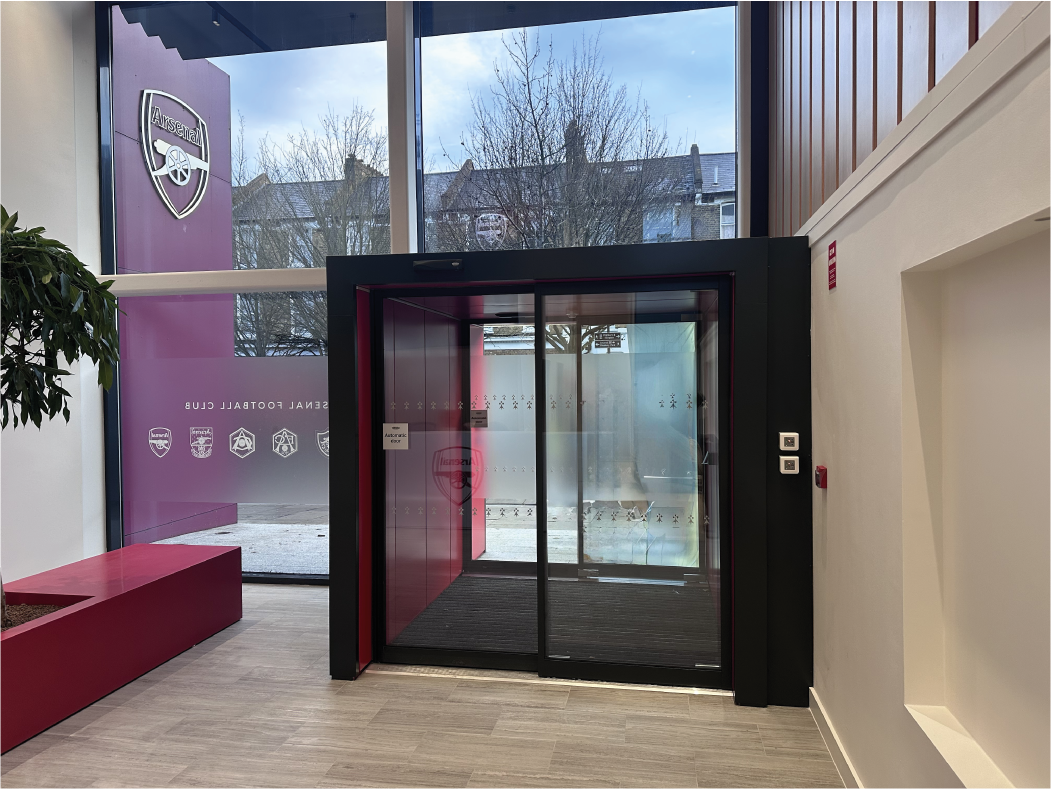
Case study: Highbury House entrance canopy, Arsenal FC
A recent example of what bespoke structural glass design looks like is the new entrance canopy at Highbury House, the administrative hub for Arsenal FC’s Emirates Stadium complex.
The brief was to replace an existing revolving door set with a secure, bespoke entrance and automated sliding doors. The new structure had to interface with the existing curtain walling, deliver a tunnel-effect aesthetic in Arsenal FC club colours, and integrate with the front desk and fire alarm.
We delivered a steel tunnel canopy wrapped in factory-pressed, custom-made metal panels with no visible fixings, finished in PPC RAL 7016 anthracite grey. Two Tormax iMotion 2022 sliding doors were installed with radar, infrared and integrated locking systems.
The project ran from a September 2025 commission to a January 2026 handover, on a 16-week programme with limited working space and ongoing trade coordination.
Handover was delivered on time, the security brief was met, and the aesthetic matched the client’s intent.
Read the full case study here
Specifying structural glass on your project
Whether the work is a single canopy, a full façade, a balustrade run or a frameless extension, the same principles apply. Bring the specialist in early, give them complete information, and look for evidence of similar projects delivered to completion.
For project-specific advice, design review or tender enquiries, contact Glasstec Systems on 020 8500 2818 or email info@glasstecsystems.com