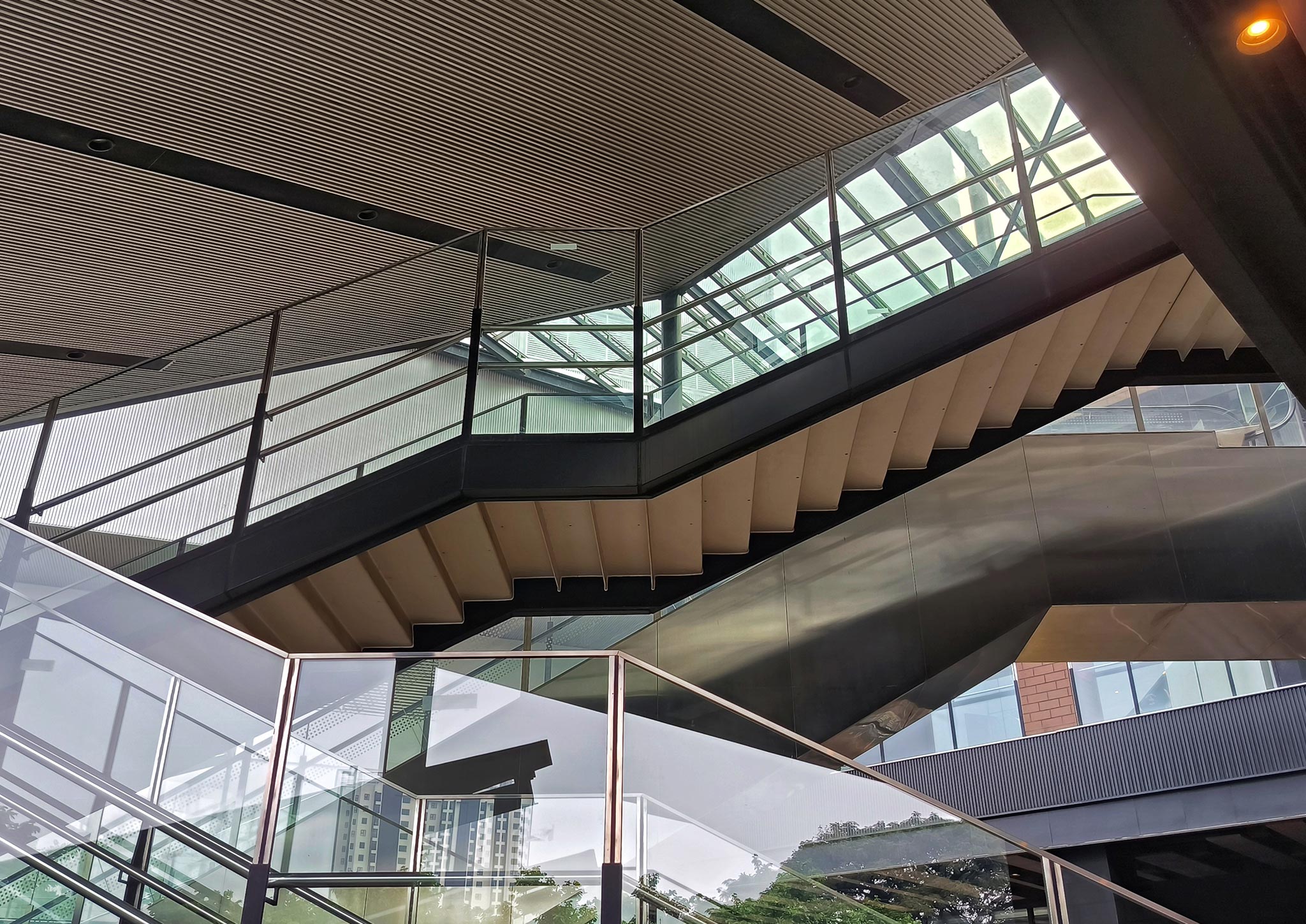
Why specify glass balustrades for commercial projects?
For architects, glass balustrades provide a balance between structural integrity and visual transparency.
In commercial spaces, where natural light and open circulation are key, glass balustrades maintain flow while complying with safety requirements.
For architects, specifying glass balustrades is not simply a matter of choosing a product for visual appeal. It involves balancing design aspirations with regulatory compliance and structural performance. Understanding how Approved Document K, Approved Document M, BS 6180:2011 and BS EN 13501-2 interact with the intended use of the building is essential.
By addressing these considerations early in the design process, architects can avoid costly redesigns and ensure that their balustrade specification will pass Building Control approval while delivering the desired architectural impact.
Achieving compliance with UK Building Regulations
The primary regulatory guidance for balustrades is set out in Approved Document K of UK Building Regulations, which addresses protection from falling, collision and impact. It requires guarding wherever there is a risk of falling more than 600mm, including staircases, ramps, landings and balconies.
Glass balustrades can be used as the guarding element, provided they meet the structural performance criteria in BS 6180:2011 Barriers in and about buildings. This standard defines the minimum line load, point load and uniformly distributed load requirements based on building type and anticipated use.
For example, offices and institutional buildings require a minimum line load of 0.74 kN/m, while retail spaces and assembly areas open to the public require higher loadings of 1.5 kN/m or even 3.0 kN/m in high-traffic environments such as shopping centres or transport facilities.
This has a direct impact on the specification of glass type, thickness and fixing method.
In addition, Approved Document M addresses accessibility and requires balustrades to incorporate features such as continuous handrails where appropriate. This ensures safe navigation for all users, including those with mobility impairments.
Architects should note that while frameless systems can often be specified without a handrail if laminated safety glass is used, Building Control may require a handrail in high-use public areas for additional safety and inclusivity.
Fire performance is also a key consideration in many commercial projects. For glass balustrades, ‘fire rated’ focuses on non-combustibility rather than compartmentation or containment.
It is important to ensure fire rated glass balustrades achieve fire classification BS EN 13501 class A2-s1,d0
An A2-s1,d0 balustrade will not add fuel, smoke or flaming droplets to a fire, but it is not designed to stop flames or heat transfer in the way an E (integrity) or EI (integrity + insulation) glazed walls, doors and partitions do.
The primary role of a fire rated glass barrier is to reduce combustibility and limit smoke and droplet emissions. Not to act as a fire barrier.
Glass types and specifications
Selecting the correct glass type is critical when specifying balustrades for commercial buildings. Performance, compliance and design intent all depend on matching the right composition to the project’s requirements.
Laminated safety glass is the standard choice for balustrades in commercial settings. It is manufactured by bonding two or more sheets of glass with an interlayer, ensuring the panel remains intact if fractured. This meets the requirements of BS EN 14449 for laminated glass and is essential in areas with high footfall or where fall protection is required.
Toughened glass (also known as tempered glass) is often used in balustrade systems because of its strength and impact resistance. Toughened glass is up to five times stronger than annealed glass of the same thickness and complies with BS EN 12150. However, it must always be laminated when used in barrier applications to avoid complete collapse if breakage occurs.
Glass thickness requirements are defined by use, location and loading standards in BS 6180:2011. Office environments typically require laminated panels of 15–17.5mm, while higher loads in public buildings may require 21.5mm or more. Structural calculations are always recommended to confirm suitability.
Interlayer options allow the glass to be tailored to specific project needs. PVB (polyvinyl butyral) interlayers are widely used for safety and UV resistance, while SentryGlas® provides increased stiffness and superior post-breakage performance, making it suitable for high-load applications. Acoustic interlayers can also be specified to reduce sound transmission in spaces such as airports or hotels.
Low-iron glass can be selected to maximise clarity and reduce the green tint associated with standard glass, which is particularly effective in retail, corporate and hospitality settings where visual quality is important.
Types of balustrade systems
Glass balustrade systems can be configured in several ways to suit both compliance requirements and architectural intent. The choice of system depends on factors such as location, loading demands, desired aesthetics, and integration with the wider building design.
Frameless glass balustrades with structural fixings are widely used in commercial projects where clean lines and unobstructed views are priorities. These systems use structural glass fixed at the base or sides (surface or side mounting options), often with concealed channels or point fixings, to create a seamless appearance without visible framing.
Glass balustrades with handrails remain a common requirement under BS 6180:2011 and Approved Document M, particularly in high-traffic public spaces. Handrails can be manufactured in stainless steel, aluminium, or powder-coated finishes to match other architectural elements. They add an additional level of safety and accessibility, particularly for inclusive design.
Semi-frameless systems with base channels provide a balance between structural integrity and visual lightness. The glass is secured within an aluminium or steel base channel, often recessed into the floor structure, which reduces the need for visible posts while still offering robust performance.
Juliet balconies and external applications are another common specification. Glass balustrades provide fall protection while maximising light and maintaining external views. For external use, considerations such as weather resistance, drainage, and thermal performance must be factored into the specification.